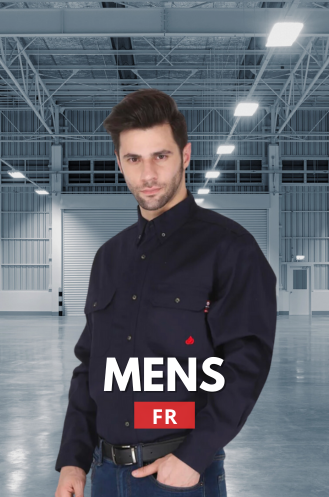

Flame resistant long sleeve shirts are the better choice for most industrial workers because they cover more skin. Short sleeve FR shirts suit hot sites with low arm exposure. This guide compares both options, so you can pick the right fire resistant work shirts for your job.
FR clothing protects against specific hazards. It does not guarantee complete protection, so always follow your site safety rules and your employer’s policy.
What Are Flame Resistant Long Sleeve Shirts?
Flame resistant long sleeve shirts are work shirts made from fabric that resists ignition and stops burning once the flame is removed. Their sleeves cover your arms from wrist to shoulder.
This extra coverage lowers the area of skin exposed to sparks, heat and flash fires. Many workers wear them as a base layer or as a top layer.
You will find these styles in the market:
- Button-front and snap-front shirts: These work as outer layers on most sites.
- FR long sleeve t shirts: These are soft, light and easy to wear under other gear.
- Crew neck styles: These fit neatly under coveralls and jackets.
The fabric may be inherently FR or chemically treated. Inherent fabric keeps its protection for the life of the garment. Treated fabric needs careful washing.
For example, the Forge FR Men’s Grey Crew Neck Long Sleeve T-Shirt,

the Navy Camo Crew Neck Long Sleeve T-Shirt and

the Sand Camo Crew Neck Long Sleeve T-Shirt offer a simple crew neck fit. Check each product page for its FR documentation before you buy.

What Are Short Sleeve FR T-Shirts?
Short sleeve FR T-shirts are flame resistant t shirts that end above the elbow. They offer fire resistance for the chest and torso with more airflow for the arms.
Workers choose them for comfort in warm places. They also work well as a base layer under a long sleeve outer shirt or a jacket.
Common uses include:
- Base layers under FR coveralls
- Hot indoor plants and workshops
- Layering under FR shirts in changing weather
Short sleeves leave your forearms bare. Therefore, they suit tasks where arm exposure is low. The Forge FR Men’s Base Layer Charcoal Grey Tee

and the Forge FR Men’s Base Layer Khaki Tee are two options to review.

The Forge FR Short Sleeve Base Layer Khaki Tee is another option, though its page lists it as coming soon.

For visibility needs, see the Men’s Hi-Vis Half Sleeve T-Shirt.

How Do Flame Resistant Long Sleeve Shirts Differ from Short Sleeve Shirts?
Flame resistant long sleeve shirts give more arm coverage, while short sleeve shirts give more airflow. That is the main difference between these fire resistant shirts.
|
Feature |
Long Sleeve FR Shirts |
Short Sleeve FR Shirts |
|
Arm coverage |
Full |
Partial |
|
Heat comfort |
Moderate |
High |
|
Spark protection |
Higher for arms |
Lower for arms |
|
Layering |
Works as outer or base layer |
Best as base layer |
|
Cold weather |
Good |
Needs a jacket |
|
Best for |
Higher-risk tasks |
Low-risk, hot tasks |
Therefore, the right choice depends on your task, your climate and your site rules.
Many workers keep both styles. They wear flame resistant long sleeve shirts for risky tasks and flame resistant t shirts for warm, low-risk work.
Which Flame Resistant Long Sleeve Shirts Are Better for Electricians?
Flame resistant long sleeve shirts are better for electricians because arc flash can burn exposed arms. Full sleeves reduce that risk.
Electrical work often involves arc flash hazards. Always check the arc rating on the label and your employer’s requirements.
Follow these points:
- Choose fire resistant work shirts with a clear arc rating when the task needs one.
- Do not wear short sleeves alone for energized work.
- Wear FR long sleeve t shirts as a base layer under an arc-rated shirt.
- Avoid synthetic underlayers that can melt.
Standards such as NFPA 70E guide workplace practice. Rely on a rating only when the label and product documents support it.
Explore Forge FR Online’s collection of FR shirts, featuring flame-resistant workwear designed to help industrial workers stay protected, comfortable, and job-ready in demanding work environments.
Which Option Works Better in Hot Weather?
Short sleeve flame resistant t shirts work better in hot weather because they allow more airflow. However, flame resistant long sleeve shirts can still work if the fabric is light.
Heat stress is a real risk on summer sites. Light fire resistant shirts help you stay cool and safe.
Try these tips:
- Pick lightweight, breathable fabric.
- Choose light colours that reflect heat.
- Drink water often and take rest breaks.
- Wear moisture-wicking base layers.
If your task needs full arm coverage, choose thin flame resistant long sleeve shirts instead of removing sleeves. Safety comes first, and comfort comes second.
For added warmth, comfort, and workplace protection, explore Forge FR's flame-resistant jackets and vests, featuring durable FR outerwear designed for industrial workers, welders, electricians, and oil and gas professionals.
How Do Workplace Hazards Influence the Choice of Flame Resistant Long Sleeve Shirts?
Your main hazard decides the shirt. Flash fire, arc flash, sparks and molten metal all call for more coverage, so flame resistant long sleeve shirts suit most high-risk jobs.
|
Industry |
Main Hazard |
Better Choice |
|
Oil and gas |
Flash fire |
Long sleeve |
|
Electrical |
Arc flash |
Long sleeve, arc-rated |
|
Welding |
Sparks and spatter |
Long sleeve |
|
Manufacturing |
Mixed heat risks |
Either, by task |
|
Warm indoor work |
Low arm exposure |
Short sleeve |
Start with a hazard assessment. Ask your safety officer which fire resistant work shirts meet your site rules.
Also consider visibility. Low-light jobs may need a hi-vis style. Then confirm that the garment carries the right FR labels for your task.
What Mistakes Should You Avoid When Choosing Flame Resistant Long Sleeve Shirts?
Avoid choosing by price alone, ignoring labels and skipping layers when you buy flame resistant long sleeve shirts.
- Ignoring the hazard: Short sleeves may not suit your task.
- Mixing fabrics: Cotton or synthetic layers can melt or burn under heat.
- Wrong size: Tight shirts restrict movement. Loose shirts snag.
- Poor care: Bleach and softener can reduce protection on treated fabric.
- Skipping inspection: Check for holes and worn seams before every shift.
Many buyers also assume all fire resistant shirts are the same. They are not. Always read the fabric details and care steps.
Finally, buy only from sellers who share clear FR information.
What Do Workers Ask About Flame Resistant Long Sleeve Shirts?
1. Are flame resistant long sleeve shirts safer than short sleeves?
They cover more skin, so they suit higher-risk tasks. Safety still depends on your hazard and gear.
2. Can I wear flame resistant t shirts alone?
Only if your site rules allow it. Most workers wear them as a base layer.
3. Are FR long sleeve t shirts good under other clothing?
Yes, they are light and fit neatly under shirts, coveralls and jackets.
4. Do fire resistant work shirts last forever?
No. Replace them when burns, holes or wear reduce protection.
5. Are fire resistant shirts fully fireproof?
No. They resist ignition and reduce burn risk, but they do not give complete protection.
Choose flame resistant long sleeve shirts for higher-risk work and short sleeves for hot, low-risk tasks. Always match your shirt to the hazard.
Follow us on Instagram for FR gear care tips, industrial safety insights, workplace protection advice, and the latest FR workwear updates.